Posts

Household Codes, Slaves and Hierarchy

Image
 I recently was drawn into an online discussion with an improbably named US dude, who was dogmatic that we must accept the "plain meaning" of the Scriptures. He claimed: "It is clearly written in the ancient scriptures.., *God, Man, Woman, Child, Creatures.* That is the order / hierarchy". But is that plain and clear? There is a reasonable biblical argment for humans over creatures: Genesis 1: 26 Then God said, “Let us make mankind in our image, in our likeness, so that they may rule over the fish in the sea and the birds in the sky, over the livestock and all the wild animals,[a] and over all the creatures that move along the ground.” 27 So God created mankind in his own image, in the image of God he created them; male and female he created them. 28 God blessed them and said to them, “Be fruitful and increase in number; fill the earth and subdue it. Rule over the fish in the sea and the birds in the sky and over every living creature that moves on ...

A plea for unity and civility

Image
It's been a bruising election campaign, but the results are in. Joe Biden is the President-elect of the USA. He has called for unity and civility. But how? Perhaps unity begins by finding a way to common ground. Perhaps it begins by believing in the good intentions of others. Perhaps it begins with a recommitment to civil discourse. Most Republican and Democrat voters want fewer poor people in the country. Republicans believe this is best achieved by encouraging private enterprise-driven employment, and through the efforts of church and private charitable endeavours. Democrats see a larger role for the state in supporting the poor and vulnerable. But neither side claims more poor people is their aspiration. They do have that in common. Most Republican and Democrat voters want fewer abortions in their country. Republicans believe the best way to achieve this is making the procedure illegal or unaffordable, and Democrats believe the best way to achieve this is to make contraception u...

Government Welfare and the Common Good

Image
I stumbled across the following statement on Facebook the other day: "Conservatives want to help poor & needy by taking responsibility & freely choosing to help. Progressives want to help by abrogating responsibility to Govt & letting them take money & redistribute it." No doubt this is intended as a generalisation: clearly some progressives engage in charitable giving, and some conservatives do not. But the premise itself intrigued me. Is private aid more effective than government welfare? This question is always relevant for democratic citizens. We regularly elect representatives who sit somewhere on a continuum in the role of government in supporting the poor.  I thought I'd crunch some numbers around what it would take for  private charity to replace the role of government welfare. Let's look at current charitable giving for starters: "An estimated 14.9 million Australian adults (80.8%) gave in total $12.5 billion to charities and ...

The War on Truth: The Players and the Risks

Image
In the War on Truth, there are many casualties. We are in the midst of a global pandemic, and the health and the lives of many are under threat from misinformation.  But there are other dangers from fake news - for social cohesion, for the West and democratic values, and even for the health of the planet. Why is there so much "Fake News"? Tactics to spread pseudoscientific misinformation were piloted by the  tobacco industry  to preserve their profits at the expense of human lives. The same tactics were then employed (and in many cases the  same people  were involved) in  climate denial . Wealthy  right-wing mega-donors  continue to promote media that supports their vested interests, and have no qualms around generating misinformation. Less prevalent but more disturbing are those on the extreme right aiming for a  collapse of society . Bizarrely, their aims are the same as the Communist states they despise. There is credible evidence Russia h...

Conspiracy Theories, Anti-Vaxxers, and a Pandemic

Image
Conspiracy theories are commonplace. They are appealing. Graham Lawton from New Scientist notes that : “Conspiracy theories can… be emotionally reassuring. They provide truthful-sounding explanations for events that otherwise seem inexplicable, random or capricious, and often make your political opponents look bad. They can also give believers a pleasing sense of superiority because they – and sometimes they alone – have seen through the lies and cover-ups to reveal the ‘truth’.” Some conspiracy theories are benign. Flat-earthers aren’t harming anyone else (although one flat earth proponent famously and tragically had his own life end in a misadventure ). However, some conspiracy theories are exceedingly dangerous. According to a 2020 March poll from The Associated Press-NORC Center for Public Affairs Research, “only about half of Americans say they would get a COVID-19 vaccine…. 31% simply weren’t sure if they’d get vaccinated. Another 1 in 5 said they’d refuse.” ...

Fires, and Debates, are Raging

Image
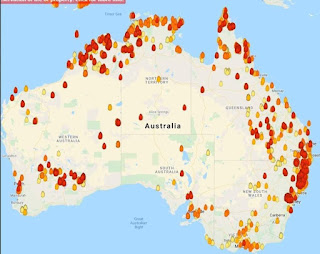
There are fires raging over much of Australia right now, triggering debate on the contribution of climate change to our current unseasonable weather. This has also led to well-meaning people reposting articles from the climate denial industry. I thought I'd record a summary of my responses for posterity. That the earth is getting warmer is a fact.* See the graph here . There are two main possible reasons the earth is getting warmer. 1) more sunlight is coming in or 2) more heat is being trapped. Option One isn’t true – solar activity has been carefully measured. See graph here . **  This leaves us with Option Two. The earth is getting warmer because more heat is being trapped in the atmosphere. But why is it so? There are several so-called greenhouse gases in the atmosphere that can trap heat (this is called ‘forcing’). Carbon dioxide, water, methane, and CFCs are among the known greenhouse gases .  Of these, carbon dioxide has the biggest im...

Toward Emotional Freedom

Image
A six-year-old boy called Nathan asks his father why his mum is crying. “Because you boys have been naughty” the father responds, referring to the boy and his younger brother. Nathan immediately feels terrible that his behaviour has caused his mother such distress. Somehow the message goes deep into his soul that he is responsible for the feelings of others. He must NEVER behave in a way that will upset others like that! Decades later, Nathan is a pastor. He feels significant anxiety when others disapprove of his words or actions, especially if they are older, respected figures. Nathan still carries an inner six-year-old who feels distressed if parental archetypes are displeased with him. Pastor Nathan is self-aware enough to realise his anxiety about pleasing others is holding him back as a leader. How might you address these kinds of deep-seated emotional responses? As Nathan’s coach I asked: “when did you first feel like you were responsible for other’s fe...

Study at Manchild!

Image
I have noticed (and heard about) some bad behaviour lately: to be more specific, bad online male behaviour involving misrepresentation of feminism and gaslighting of women. My curiosity was aroused by noticing similar patterns of behaviour from different people in different places. How are they learning these techniques? I’ve hypothesised an educational institution exists where such behaviour can be honed to perfection. What do you think of my proposed curriculum? What subjects should be added? Manchild Christian University Subject Choices Here at Manchild we teach you: Selective Biblical Literalism 101 We'll show you how the 59 references to slaves in the New Testament need to be read on their cultural context, while explaining how taking l Timothy 2:12 literally is a test of biblical orthodoxy, and that anyone who doesn't ban all women from leadership is a HERETIC! Women's Issues 102 We will help you develop a pat answer to every complex...

Political Correctness or Plain Politeness?

A number of years ago my sister and I took our parents to a rather elegant restaurant for lunch. It was a converted old manor house with beautiful old rooms and quiet carpeted floors; utterly unlike the hard-floored echo chamber of a typical Melbourne café. The gentle clink of cutlery and quiet conversations were the only sounds. I note this because at a strategic moment when everyone in the restaurant went silent, my father dropped the n-word. Nigger. It was like all the oxygen was sucked out of the room. “Dad!!!! You can’t say that!!!” my sister said in horror. “What did I say? What’s wrong with that?” he replied. My father was born in 1916 in country Victoria, and in his mind describing someone of African origin as a “nigger” was descriptive. In this embarrassing context, my sister and I tried to explain that the n-word is considered a highly offensive racial slur. Political correctness means “the avoidance of forms of expression or action that are perc...

Faith and Order and Blurring the Two

Image
There are things all Christian traditions agree on (faith questions), and areas where there are significant differences around how churches organise and describe themselves (order questions). This is reflected in the name of the World Council of Churches Faith and Order Commission, where theological dialogue occurs.  Mormons, Jehovah's Witnesses, Christedelphians and others cannot join the World Council of Churches as they do not  “confess the Lord Jesus Christ as God and Saviour according to the Scriptures… to the glory of the One God, Father, Son and Holy Spirit.” There are however a huge variety of churches that belong to the World Council of Churches. They have diverse views on women in ministry, modes of baptism, communion, the priesthood, the weight of scripture vs tradition, etc. These are "order" questions, not "faith" questions. How should Christians manage their relationships with one another around differences over these secondary quest...

Rebranding Hierarchy

Once upon a time, I was involved in the Monash University branch of AFES/Intervarsity called “The Evangelical Union”. This was the early 1980s, and young men and women alike were leading everything. The term Complementarian wasn't yet a twinkle in Wayne Grudem's eye.* In this period, egalitarian theologians were arguing that men and women were designed to complement one another; that we needed both women and men in leadership. In society more broadly, the ideal of a gender hierarchy was being profoundly challenged. The idea was normalised that women should have equal legal and workplace rights to men - in theory if not in practice. By the late 1980s, Christian conservatives who believed in a gender hierarchy found themselves with an image problem. They were becoming theologically marginalised, as well as out of step with society at large. It was time for a rebranding exercise. To quote Scot McKnight: 'Grudem tells us that he and John Piper,...

Christmas Reflection

Raymond Carver’s pithy poem ‘Late Fragment’ captures something of the yearning of every human heart: And did you get what You wanted from this life, even so? I did And what did you want? To call myself beloved, to feel myself Beloved on the earth At Christmas time, most of us gather with friends and family. Our time, our gifts and our eating together are symbols of love and belonging. For Christians, commemorating the birth of Jesus Christ connects us with a transforming message: “For God so loved the world that he gave his only son” (John 3:16). We are not alone in the universe, or insignificant. Our lives are not meaningless. Rather, we are beloved : Christ was born and lived and died and rose to express God’s profound love for us. Did you get what you wanted from this life, even so? My prayer for this Christmas is that you will experience what all of us really want: that you will feel yourself beloved on the earth. For you are... more than ...

Proof Text Inconsistency

I’m over it! As an egalitarian, periodically on social media I am accused of not being faithful to God’s word, but compromising to culture. Here is the latest example: “Men and women are equal before God but have different roles. 1 Timothy 2:12 is clear. ‘I do not permit a woman to teach or to exercise authority over a man; rather, she is to remain quiet.’ It is vital that we stand on God's Word, not bowing to cultural pressures.” (1) The first thing to note is that this text is anything but clear, using the rare and ambiguous word authentein . But secondly… I am yet to meet ANYONE online who doesn’t “compromise to culture” around the following passages. (2) Note these are passages that do not involve ANY ambiguous Greek words: Romans 16:16 “Greet one another with a holy kiss.” 1 Corinthians 16:20 Greet one another with a holy kiss. 2 Corinthians 13:12 Greet one another with a holy kiss. 1 Thessalonians 5:26 Greet all the brothers and sisters with a holy...

Theology and Culture in Dialogue

I've been involved in yet another Facebook dialogue - a respectful one - on women in ministry and eldership. The person expressed concern that having women in ministry was caving in to cultural pressure, and noted that " many churches have changed their position in such a brief period of time (relatively speaking, in the span of church history)" He also commended Grudem and Piper's theological (Complementarian) position. My response is below : I would like to reflect on your comment “it is vital that we stand on God’s word” (yes!) “not bowing to cultural pressures” (yes, but…) May I say – somewhat provocatively – that theology is always developed in the context of, in dialogue with, and in contrast to culture. The theology of God’s people (revealed in the Old Testament) was developed in the context of and in contrast to other cultures – in Egypt, Palestine, and Babylon. Jesus’ teaching was in the context of first century Roman-occupied Palestine; a...

"Defending" Women in Ministry

Steven Holmes claims he can no longer defend women in ministry. I'm inclined to agree with him! What do you think?

Updates on the Trinity and Complementarian Theology

Kevin Giles has been writing for the past 20 years about how some Complementarians have been rewriting the doctrine of the Trinity. It seems finally the gravity of this problem is sinking in. Scot McKnight has discussed Kevin's latest book here . An excerpt for your interest: "Kevin Giles, who all along has been calling out Grudem and Ware and others, both was the first to call them out and now has written a small engaging account called The Rise and Fall of the Complementarian Doctrineof the Trinity. He has issued statement after statement but the authorities in the complementarian movement denounced him, ignored him, and therefore silenced him. But when the Reformed lights... came to his side, defended him, and denounced the inadequate and wrong-headedness of Grudem and Ware, the jig was up and suddenly Giles was no longer the bad guy. They will still largely ignore him, but the truth is out." Last year Christianity Today did a fairly cutting expose of the mot...